


Contents
Scroll to:
 A. V. Ivanov,
N. V. Bryansky,
U. S. Efremova,
E. A. Gladkochub,
A. A. Karimov,
E. I. Demonterova,
E. A. Mikheeva,
Yu. D. Shcherbakov,
A. S. Dubenskiy,
V. S. Sheshukov,
K. G. Erofeeva,
O. I. Okina,
V. B. Khubanov,
D. V. Semenova,
A. V. Karpov,
N. V. Rodionov,
V. G. Davydov,
A. N. Larionov,
S. L. Votyakov,
M. V. Chervyakovskaya,
V. S. Chervyakovsky,
E. A. Pankrushina,
D. A. Mandrygina,
A. V. Kulikova,
K. R. Minnebaev,
L.-L. Zhang,
N. M. Kudryashov
A. V. Ivanov,
N. V. Bryansky,
U. S. Efremova,
E. A. Gladkochub,
A. A. Karimov,
E. I. Demonterova,
E. A. Mikheeva,
Yu. D. Shcherbakov,
A. S. Dubenskiy,
V. S. Sheshukov,
K. G. Erofeeva,
O. I. Okina,
V. B. Khubanov,
D. V. Semenova,
A. V. Karpov,
N. V. Rodionov,
V. G. Davydov,
A. N. Larionov,
S. L. Votyakov,
M. V. Chervyakovskaya,
V. S. Chervyakovsky,
E. A. Pankrushina,
D. A. Mandrygina,
A. V. Kulikova,
K. R. Minnebaev,
L.-L. Zhang,
N. M. Kudryashov https://doi.org/10.5800/GT-2026-17-3-0897
EDN: OSVYNP
Scroll to:
This study presents U-Pb dating results for zircon collected from the beaches of recreation zone "Peschanaya" (Sandy) on Lake Baikal. These beaches are formed exclusively by the erosion of Early Proterozoic rapakivi granites from the Primorsky Complex. Zircon from the granites yields a U-Pb age (ID-TIMS) of 1859±16 Ma, with an average U concentration of ~120 μg/g. Analysis of detrital zircon from the beaches of recreation zone "Peschanaya" was conducted using the ID-TIMS method on three aliquots and two in-situ methods – LA-ICP-MS and SHRIMP – on multiple (>600) individual grains. The new ID-TIMS and SHRIMP data are in complete agreement with each other, yielding ages of 1853.6±6.5 Ma and 1853.0±3.3 Ma, respectively. The LA-ICP-MS data, obtained in 7 Russian and 1 Chinese laboratory, are in general consistence with these results. Zircon from the beaches of the recreational zone "Peschanyа" is recommended as a secondary standard for U-Pb dating of early Precambrian samples.
Ivanov A.V., Bryansky N.V., Efremova U.S., Gladkochub E.A., Karimov A.A., Demonterova E.I., Mikheeva E.A., Shcherbakov Yu.D., Dubenskiy A.S., Sheshukov V.S., Erofeeva K.G., Okina O.I., Khubanov V.B., Semenova D.V., Karpov A.V., Rodionov N.V., Davydov V.G., Larionov A.N., Votyakov S.L., Chervyakovskaya M.V., Chervyakovsky V.S., Pankrushina E.A., Mandrygina D.A., Kulikova A.V., Minnebaev K.R., Zhang L., Kudryashov N.M. A POTENTIAL EARLY PROTEROZOIC ZIRCON REFERENCE MATERIAL BAI-1-2023 FOR IN SITU U-Pb DATING. Geodynamics & Tectonophysics. 2026;17(3):897. https://doi.org/10.5800/GT-2026-17-3-0897. EDN: OSVYNP
In recent years, there has been an explosive increase in the number of publications incorporating U-Pb isotope dating of zircon using in-situ techniques. Accurate accounting for U-Pb fractionation during analysis requires standards with a matrix similar to that of the mineral being dated. It is important to note that such standards are desirable across the widest possible range of uranium concentrations and ages. However, most zircon standards are no older than ~1.1 Ga, with only two rarely used early Precambrian standards available at ~1.8 and ~3.5 Ga (Table 1). This study has a dual significance: (1) to verify the accuracy of Russian laboratories performing zircon dating using in-situ U-Pb analysis methods, and (2) to propose a potential new natural zircon standard that would at least partially fill the existing gap in the range of ancient ages (Table 1).
Table 1. Recommended zircon standards for U-Pb in-situ dating
|
Standard |
Recommended ID-TIMS age, Ma |
U concentration range, µg/g |
References |
|
FCT-1 |
28.476±0.029 |
~200–850 |
[Schmitz, Bowring, 2001] |
|
Plešovice |
337.16±0.11 |
~460–3100* |
[Sláma et al., 2008; Horstwood et al., 2016] |
|
Temora-2 |
416.78±0.33 |
~80–320* |
[Black et al., 2004] |
|
R33 |
418.9±0.4 |
~60–400 |
[Black et al., 2004] |
|
BR266 |
559.0±0.3 |
~870–960 |
[Stern, 2001] |
|
M257 |
561.3±0.3 |
~790–900 |
[Nasdala et al., 2008] |
|
GJ1 |
601.86±0.37 |
~210–420 |
[Horstwood et al., 2016; Jackson et al., 2004] |
|
Mud Tank |
731.65±0.49 |
~5–30 |
[Horstwood et al., 2016; Gain et al., 2019] |
|
91500 |
1063.51±0.39 |
~70–85 |
[Wiedenbeck et al., 1995; Horstwood et al., 2016] |
|
AS3 (Duluth) |
1099.1±0.2 |
~110–630 |
[Schmitz et al., 2003] |
|
QGNG |
1842.0±3.1 |
~35–630 |
[Black et al., 2003] |
|
OG1 |
3465.4±0.6 |
~120–230 |
[Stern et al., 2009] |
Note. * – high U concentrations in Plešovice zircon are found in zones that are not recommended for use for calibration of U-Pb fractionation. Experience in working with the Temora 2 standard at the Center for Isotopic Research of the Karpinsky Russian Geological Research Institute (Saint Petersburg) has shown that this standard also contains high-uranium zones.
The zircon under study was collected from sandy-gravel beaches on the western shore of Lake Baikal near the "Peschanayа" recreational zone. These beaches are located in inlets known as (from south to north): Zavernyakha Cove, Akademicheskaya Cove, Peschanayа Bay, and Babushka Cove (Fig. 1, a). Sandy material is found in noticeably smaller volumes further north in Vnuchka and Sennaya coves.

Fig. 1. Complex of sand-gravel beaches in the area of recreation zone "Peschanaya" (Sandy).
(а) – view in Google Earth (numbers indicate sand sampling locations from which zircon was extracted for analysis); (b) – winter photograph of Peschanaya Bay, with a description of geomorphological elements based on [Wika et al., 1999].
The gravel and sand were formed by the weathering of rapakivi granites of the Primorsky Complex, which outcrop as cliffs. These bedrock outcrops of rapakivi granites are partially covered by their own weathering products, consisting of fragments of various sizes, gravel, and coarse-grained sand. In the coastal zone, the sand and gravel are rounded by wave action. Some of the sand is redeposited up the slope by winds blowing from Lake Baikal (Fig. 1, b).
A comprehensive geomorphological description of the "Peschanayа" recreational zone coves is provided in the book [Wika et al., 1999]. Notably, it points out that even among the aeolian deposits, unrounded grains predominate, indicating a local source for the sand.
The sand samples, from which the zircon grains were subsequently extracted, were collected at three locations: directly within the coastal zone of Zavernyakha Cove, approximately 50 meters from the shoreline in Babushka Cove, and in the middle part of the aeolian sand cover in Peschanayа Bay (Fig. 1, a, b).
Rapakivi granites in Sennaya Cove were previously dated by the U-Pb method on zircon using the ID-TIMS method to 1859±16 Ma [Donskaya et al., 2003]. The U content in zircon is ~120 μg/g [Donskaya et al., 2003].
For zircon characterization, most laboratories involved in this study employed optical microscopy (OM), scanning electron microscopy (SEM) with backscattered electron (BSE) and/or cathodoluminescence (CL) imaging. Two laboratories additionally used Raman spectroscopy. General information on the methods and equipment used is provided in Table 2.
Table 2. The methodologies and equipment used for the description and dating of zircon Bai-1-2023
|
Institution |
Methods |
Equipment |
Key references |
|
Institute of the Earth’s Crust, Siberian Branch of the Russian Academy of Sciences, Irkutsk, Russia |
Optical microscopy Raman LA-Q-ICP-MS |
Olympus microscope WiTec Alpha 300R Analyte Excite (193 nm) + Agilent 7900 |
[Ivanov et al., 2022] |
|
Vinogradov Institute of Geochemistry, Siberian Branch of the Russian Academy of Sciences, Irkutsk, Russia |
SEM BSE, CL |
Tescan MIRA 3 LMH |
[Skuzovatov et al., 2022] |
|
Dobretsov Geological Institute, Siberian Branch of the Russian Academy of Sciences, Ulan-Ude, Russia |
SEM BSE LA-SF-ICP-MS |
LEO1430VP NWR (213 nm) + Element XR |
[Kanakin et al., 2022] |
|
Geological Institute, Russian Academy of Sciences, Moscow, Russia |
LA-SF-ICP-MS |
NWR (213 nm) + Element XR |
– |
|
Sobolev Institute of Geology and Mineralogy, Siberian Branch of the Russian Academy of Sciences, Novosibirsk, Russia |
SEM SE, CL, LA-SF-ICP-MS |
LEO1430 Analyte Excite (193 nm) + Element XR |
[Semenova et al., 2024] |
|
Zavaritsky Institute of Geology and Geochemistry, Ural Branch of the Russian Academy of Sciences, Yekaterinburg, Russia |
SEM BSE, CL Raman LA-Q-ICP-MS |
LabRAM HR800 Evolution NWR (213 nm) + NexION 300S |
[Votyakov et al., 2022; Zaitceva et al., 2016] |
|
Institute of Geology and Petroleum Technologies, Kazan Federal University, Kazan, Russia |
LA-Q-ICP-MS |
Analyte Excite (193 nm) + iCAP-Q |
[Minnebaev et al., 2025] |
|
Karpinsky Russian Geological Research Institute, Saint Petersburg, Russia |
SEM BSE, CL SIMS LA-SF-MC-ICP-MS |
CamScan MX2500 SHRIMP-IIe LSX-213 G2+ + Neptune |
[Rodionov et al., 2012] |
|
Institute of Earth Sciences, China University of Geosciences, Beijing, China |
LA-Q-ICP-MS |
NewWave 193 UC + Agilent 7900 |
[Zhang et al., 2019] |
|
Geological Institute, Kola Science Centre of the Russian Academy of Sciences, Apatites, Russia |
OM ID-TIMS |
Finnigan-MAT-262 (RPQ) |
[Kudryashov, Mokrushin, 2011] |
Note. The research conducted at the SRF "Geoanalyst" was carried out under the state assignment of the A.N. Zavaritsky Institute of Geology and Geochemistry UB RAS, No. 12301180012-9. The research at the SRF for Multielemental and Isotopic Studies was carried out under the state assignment of the Sobolev Institute of Geology and Mineralogy SB RAS, No. FWZN-2026-0018, the research at the SRF for Isotope-Geochemical Studies of the Vinogradov Institute of Geochemistry SB RAS, was carried out under state assignment No. FWEG-2026-0013, the research at the SRF of the Geological Institute RAS was carried out under the state assignment of the Geological Institute RAS No. 123032400058-6.
U-Pb dating was conducted using isotope dilution thermal ionization mass spectrometry (ID-TIMS) on three aliquots weighing from 0.6 to 1.5 mg, and by two in situ analytical methods. The majority of laboratories used laser ablation inductively coupled plasma mass spectrometry (LA-ICP-MS). Mass spectrometers with two types of analyzers were employed – quadrupole (Q-ICP-MS) and sector field (SF-ICP-MS). One laboratory used a sector field multi-collector ICP-MS (SF-MC-ICP-MS). For ablation, either 213 nm solid-state lasers or 193 nm excimer lasers were used. A double-volume laser ablation cell was utilized in all cases. One laboratory employed secondary ion mass spectrometry (SIMS) using the SHRIMP-IIe instrument with an oxygen ion source. This information is summarized in Table 2.
The zircon grains are represented by fragments, and less commonly, by fully preserved crystals. The crystals reach up to 300 µm along their long axis and 150 µm along their short axis. Most grains are transparent; approximately half of the grains exhibit weak coloration due to radiation damage, while the other half, with insignificant radiation damage, are colourless (Fig. 2, а). Gas-liquid inclusions and inclusions of other minerals are commonly present within the grains.
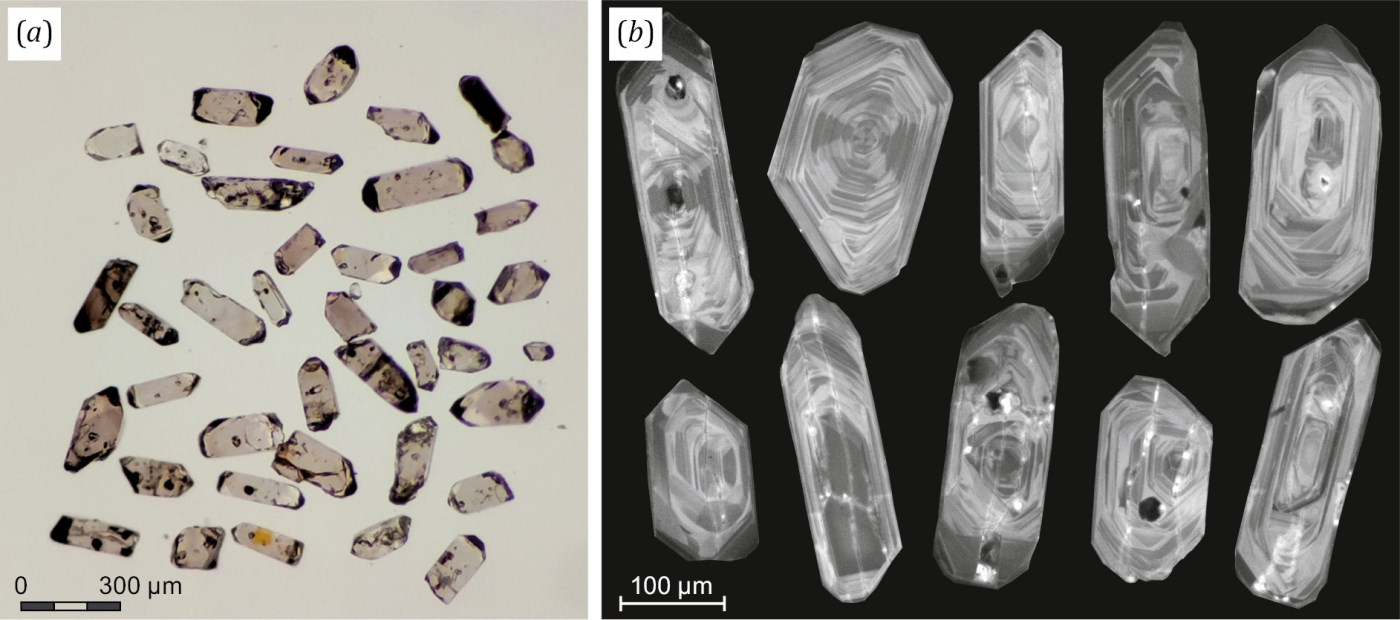
Fig. 2. Photos of Bai-1-2023 zircon grains under an optical binocular microscope (а) and SEM CL (b). Images are taken at the Institute of the Earth’s Crust SB RAS (Irkutsk) and Sobolev Institute of Geology and Mineralogy SB RAS (Novosibirsk), respectively.
The intact crystals are prismatic with a predominant length-to-width ratio ranging from 1.5 to 4 (Fig. 2, a, b). Growth (oscillatory) zoning is clearly visible on the CL images (Fig. 2, b). All these features are characteristic of zircon of magmatic origin [Corfu et al., 2003]. Some grains show areas of post-magmatic recrystallization [Pidgeon, 1992], presumably under autometasomatic conditions (Fig. 2, b).
Fig. 3 presents the results of a combined SEM CL and Raman study of a single zircon grain with a length-to-width ratio of 4. This grain has two distinct domains: a central one with two uniform light and dark zones, and a marginal one where growth zoning is clearly visible, manifested on the CL image as alternating light and dark bands (Fig. 3, a).

Fig. 3. An example of a comprehensive study of zircon grain Bai-2023. SEM CL image using Tescan MIRA 3 LMH at Vinogradov Institute of Geochemistry of the SB RAS, Irkutsk (а), Raman spectrum using WITec 300R at the Institute of the Earth’s Crust SB RAS, Irkutsk (b), and FWHMν₃ profiles across (c) and along (d) the grain. Degree of metamictization is after [Gao, Heide, 2020].
Fig. 3, b, shows a characteristic Raman spectrum featuring all vibrational modes – the external mode (ER), ν1, ν2, and ν3 (Fig. 3, b). The full width at half maximum of the ν3 peak (FWHMν3) is commonly used to assess the degree of zircon metamictization [Gao, Heide, 2020; Härtel et al., 2022]. Fig. 3, c, d, display FWHMν3 profiles measured across and along the zircon grain, respectively. It is evident that the FWHMν3 values vary within a narrow range, lying at the boundary between fully crystalline and partially damaged zircon with an intermediate degree of radiation damage.
The zircon grains exhibit fairly intense luminescence. Their typical CL spectra, obtained with a spatial resolution of approximately 1 µm, are presented in Fig. 4. The integrated luminescence intensity varies by more than an order of magnitude between grains; the spectra have a complex, superimposed character (Fig. 4). Three groups of broad bands can be distinguished: in the near-UV (Ai), blue-green (Bi), and yellow (Ci) spectral regions with maxima at 4.3–5.0 eV, 2.6–3.5 eV, and 2.1–2.3 eV, respectively. In addition to these broad bands, the CL spectra also show narrow emission lines caused by ions such as Dy³⁺, Tb³⁺, and Gd³⁺ substituting for Zr⁴⁺ ions in the mineral structure.

Fig. 4. Typical CL spectra in different grains of zircon Bai-1-2023 obtained using Jeol JSM6390LV with Horiba H-CLUE iHR500 at Zavaritsky Institute of Geology and Geochemistry UB RAS, Yekaterinburg.
Initially, zircon grains separated from sand samples of Zavernyakha Cove (Bai-1-2023, n=38), Peschanayа Bay (Bai-3-2023, n=41), and Babushka Cove (Bai-2-2023, n=42) were dated using the LA-ICP-MS method at the Institute of the Earth’s Crust, Siberian Branch of the Russian Academy of Sciences. The obtained age values for the three samples showed no statistical differences from each other and generally agreed with the published ID-TIMS age [Donskaya et al., 2003]. Given that the data for sample Bai-1-2023 from the sands of Zavernyakha Bay exhibited the smallest scatter in ages, zircon grains from this sample were provided for investigation in other laboratories.
Fig. 5 presents a comparison of the results obtained by the ID-TIMS and SHRIMP methods. It is evident that the data from both methods are in good agreement, with the only differences being that the ID-TIMS method is characterized by lower analytical error, and the in-situ SHRIMP method allows for the selection of domains for dating that are free of radiogenic lead loss, which is not feasible in the ID-TIMS study that utilized relatively large zircon aliquots with a total mass ranging from 0.6 to 1.5 mg (Table 3). Most of the SHRIMP measurements plot on the concordia; however, there are values with discordance up to 5 % (U-Pb data obtained by SHRIMP are provided in Suppl. 1 (see article page online)). Discordance values for the ID-TIMS method range from 2.0 to 5.2 %. The ages calculated from the discordia in both the ID-TIMS and SHRIMP methods do not differ from each other – 1861±10 and 1853.6±6.5 Ma, respectively (Fig. 5). If the two most discordant points are excluded, the SHRIMP method yields a concordia age of 1853.0±3.3 Ma.

Fig. 5. Comparison of U-Pb dating of zircon Bai-1-2023 obtained by ID-TIMS (dark gray ellipses) with SHRIMP-IIe method (transparent ellipses). The diagram was plotted using IsoplotR software [Vermeesch, 2018].
Table 3. Data on dating of Bai-1-2023 zircon by ID-TIMS
|
No |
Concentration |
Isotopic ratios |
Rho |
Age, Ma |
|||||||
|
Pb |
U |
²⁰⁶Pb/²⁰⁴Pb |
²⁰⁷Pb/²⁰⁶Pb |
²⁰⁸Pb/²⁰⁶Pb |
²⁰⁶Pb/²³⁸U |
²⁰⁷Pb/²³⁵U |
²⁰⁶Pb/²³⁸U |
²⁰⁷Pb/²³⁵U |
²⁰⁷Pb/²⁰⁶Pb |
||
|
1 |
45.9 |
122.6 |
1382 |
0.12284±5 |
0.20159±4 |
0.3253±8 |
5.079±13 |
0.95 |
1816±5 |
1833±5 |
1852±2 |
|
2 |
52.9 |
121.1 |
1157 |
0.12482±5 |
0.33784±10 |
0.3215±8 |
5.025±15 |
0.85 |
1797±5 |
1824±5 |
1854±4 |
|
3 |
42.7 |
98.8 |
1133 |
1.12512±5 |
0.34831±10 |
0.3151±9 |
4.915±17 |
0.85 |
1763±5 |
1805±6 |
1855±4 |
Note. Aliquot 1 – mass 1.5 mg, fraction size 100–150 µm; Aliquot 2 – mass 0.6 mg, fraction size 75–100 µm; Aliquot 3 – mass 0.7 mg, fraction size <100 µm. Isotopic ratios were corrected for mass fractionation, blank contamination, and common lead using the model of [Stacey, Kramers, 1975]. All errors in the table are quoted at the 2σ level. Analytical uncertainties in the U-Pb ratios were 0.5 %, which were used in the age calculation.
The original LA-ICP-MS data from all laboratories are provided in an Suppl. 1. For the purpose of this paper, the data obtained by each laboratory were processed uniformly, with concordia ages calculated and presented in Fig. 6.

Fig. 6. Results of U-Pb dating by LA-ICP-MS from eight laboratories (see Table 2).
Green ellipses used for concordia age calculation; transparent ellipses – values excluded from the calculations. The diagram was constructed using the IsoplotR program [Vermeesch, 2018]. The diagrams are arranged in order of increasing age: (1) Yekaterinburg – Zavaritsky Institute of Geology and Geochemistry UB RAS; (2) Beijing – Institute of Earth Sciences, China University of Geosciences; (3) Novosibirsk – Sobolev Institute of Geology and Mineralogy SB RAS; (4) Irkutsk – Institute of the Earth’s Crust SB RAS; (5) Moscow – Geological Institute RAS; (6) Saint-Petersburg – Karpinsky Russian Geological Research Institute; (7) Ulan-Ude – Dobretsov Geological Institute SB RAS; (8) Kazan – Institute of Geology and Petroleum Technologies, Kazan Federal University.
The Th-Pb dating was performed by one SHRIMP laboratory and four LA-ICP-MS laboratories (Suppl. 1). It should be noted that, except for the two most discordant points in the U-Pb isotopic coordinates, the average of 38 analyses obtained by the SHRIMP method yielded a Th-Pb age of 1847.7±9.8 Ma, which is consistent with the U-Pb concordant age. None of the LA-ICP-MS laboratories were able to obtain a Th-Pb date consistent with the U-Pb dating, which is evidently related to methodological issues in the LA-ICP-MS laboratories.
All laboratories initially received information about the magmatic origin of the Bai-1-2023 zircon and its Early Proterozoic age, without being provided with expected age values. Each laboratory originally applied its own approach to selecting grains for analysis, determining the number of analysis spots per grain, choosing which standard to use as the primary one, the data reduction method, and selecting which isotopic ratios to use for age calculation.
The results of the interlaboratory comparison test for the Bai-1-2023 zircon showed [Ivanov et al., 2025] that all participating laboratories proposed an interpreted age consistent with the published ID-TIMS age of 1859±16 Ma for the rapakivi granites [Donskaya et al., 2003]. This study obtained an ID-TIMS date with lower uncertainty directly for Bai-1-2023 zircon collected from the Zavernyakha Cove: 1853.6±6.5 Ma (see Fig. 5). The dating result obtained by the SHRIMP method is fully consistent with the ID-TIMS date, yielding 1853.0±3.3 Ma. The dates obtained by the LA-ICP-MS method in most laboratories overlap within analytical error with the new ID-TIMS date; however, there is a tendency for overestimation of LA-ICP-MS dates in several laboratories (Fig. 7). The ID-TIMS value of 1853.6±6.5 Ma is recommended as the reference age for the Bai-1-2023 zircon. The maximum deviation from the reference value was obtained in Laboratory 8 and amounts to 0.6 % of the age.

Fig. 7. Comparison of data acquired by in situ analytical techniques (SHRIMP – open rectangles; LA-ICP-MS – green rectangles) with ID-TIMS data (gray field). Numbers inside the rectangles correspond to numbers of the laboratories marked in Fig. 6.
Mineral standards for U-Pb dating by in situ analysis methods must meet the following key requirements: firstly, their age must be reliably determined, for instance, by the ID-TIMS method; secondly, they must be homogeneous; and thirdly, they must be available in sufficient quantity for repeated analysis. Such standards serve two functions: they are used to calibrate the age calculation of unknown samples relative to a chosen primary standard, and they are employed as secondary standards to assess analytical accuracy and compare results between different laboratories.
The first and third requirements are fully met by the Bai-1-2023 zircon. Its ID-TIMS age is known and confirmed by the SHRIMP method, and the amount of sand containing this detrital zircon, derived from the original rapakivi granites, is virtually limitless. Regarding the second requirement, the U-Pb dating data indicate that within the grains, there are domains with significant radiogenic lead loss, disturbance of the U-Pb isotopic system, and the presence of common lead (see Fig. 6). This necessitates additional control during the analysis of the Bai-1-2023 zircon and a more careful approach to spot selection than is typically performed in the routine analysis of other zircon standards.
When compared to other common zircon standards, the Bai-1-2023 zircon is characterized by higher degrees of discordance, based on ID-TIMS data (Table 4). However, it should be noted that the ID-TIMS analysis was performed on large aliquots (0.6 to 1.5 mg). Given the typical grain size in rapakivi granites, such aliquots contain hundreds of zircon grains. Clearly, with such a large number of grains, it is difficult to select only those entirely free of defects and inclusions. At the same time, the in situ analytical methods used in this study show that it is generally not difficult to select a single spot with a diameter of up to 35 µm on a grain that yields a concordant result. However, the probability of hitting an inhomogeneous domain with cracks, inclusions, or high radiation damage increases when selecting multiple spots on a single grain. Thus, out of 673 analyses performed by the LA-ICP-MS method in 8 laboratories, 70 were rejected (mostly due to two laboratories), which ultimately amounts to just over 10 %. Therefore, it is recommended to analyze no more than two spots per grain for the Bai-1-2023 zircon.
Table 4. The FWHMν3 values, degrees of radiation damage, and bulk discordance of Bai-1-2023 zircon compared to other zircon standards
|
Standard |
FWHMν3 |
Degree of radiation damage |
Discordance % after ID-TIMS* |
|
Bai-1-2023 |
4.5–14 |
From negligible to intermediate |
2.0–5.2 |
|
Plešovice |
7.8–11.8 |
Intermediate |
0–1.7 |
|
Temora-2 |
5.9–6.6 |
Intermediate |
0–1.7 |
|
GJ1 |
6.2–6.8 |
Intermediate |
0.7–1.0 |
|
Mud Tank |
2.2–2.5 |
Negligible |
0.3–0.5 |
|
91500 |
3.7–3.9 |
Negligible |
0–0.6 |
Note. FWHMν3 data for the Plešovice, Temora, GJ-1, Mud Tank, and 91500 standards are from [Votyakov et al., 2022]. Discordance was calculated based on data from the studies listed in Table 1. Discordance for Bai-1-2023 is taken from Table 3. * – discordance is calculated as 100·[²⁰⁷Pb/²⁰⁶Pbage/²⁰⁶Pb/²³⁸Uage–1] without taking into account analytical uncertainty.
In terms of the degree of radiation damage, assessed by the FWHMν3 parameter, the Bai-1-2023 zircon is most similar to the Plešovice, Temora-2 and GJ-1 standards, which are characterized by an intermediate degree (i.e., partially damaged) of radiation damage (Table 4). The metamictization of zircon can also be assessed using cathodoluminescence (CL) centers [Votyakov et al., 2022]. For instance, the Ci centers correspond to the well-known "classical" yellow luminescence of the mineral. The appearance of yellow emission is associated with defects in the silica-oxygen sublattice – various types of oxygen vacancies and divacancies in SiO4 tetrahedra; these defects cause a reduction in the crystallinity of the matrix, which directly depends on the U and Th content. The Ci centers can be conditionally classified as radiation-related. The UV and blue-green Ai and Bi centers are typical of a low-impurity, highly crystalline zircon matrix. Increased emission intensity of these centers reliably indicates matrix sterility and its high crystallinity (absence of a metamict component). The ultraviolet Ai centers represent a superposition of several elementary bands А1–3, caused by recombination transitions between electronic sub-levels of irregular defective zirconium-oxygen dodecahedra. These differ from each other in their symmetry and electronic structure and contribute variably to the integral emission spectrum of the Ai center. The incorporation of Ti ions – close crystallochemical analogs of Zr ions – into the mineral’s structure is linked to the appearance of blue-green emission, the Bi centers. The internal structure of this center (bands B and B1) is determined by symmetrical and dimensional differences in the nearest oxygen environment of Ti ions substituting for Zr in the mineral structure.
Following the work of [Votyakov et al., 2022], a triple Аi – Вi – Сi diagram, showing the ratio of the integrated areas of the mentioned broad bands, was used to discriminate zircon grains based on their luminescence properties (Fig. 8). It can be seen that the positions of data points corresponding to the Bai-1-2023 zircon grains form an extended zone, primarily along the Ci side, which overlaps with the zones for GJ-1, Plešovice, and to a lesser extent, the 91500 standard (Fig. 8).
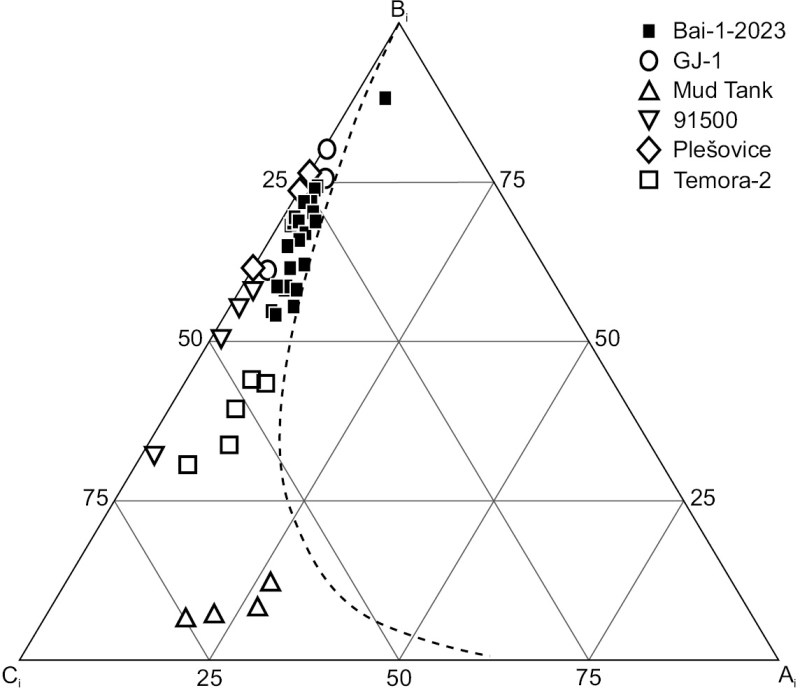
Fig. 8. The ratio of the integral areas of the Аi – Вi – Сi bands in the CL spectra of zircon Bai-1-2023 in comparison with data for some other zircon standards after [Votyakov et al., 2022].
Datable zircon grains, especially those of Early Precambrian age, are rarely free from radiation damage, other defects, and inclusions-unlike the zircon standards used as primary reference materials. In other words, using defect-free zircon to control the accuracy of measurements on "defective" zircon reveals nothing about the correctness of the analysis of that "defective" zircon. In this sense, the imperfections of the Bai-1-2023 zircon are its strengths if it is used as a secondary standard for verifying the accuracy of analyses of real Early Precambrian zircon grains.
The detrital zircon from the beaches of the bay complex (coves) of Lake Baikal, collectively known as recreation zone "Peschanayа" (Sandy) is exclusively a product of the weathering of local outcrops of rapakivi granite from the Primorsky Complex. One sample of this detrital zircon (Bai-1-2023) was analyzed by one ID-TIMS laboratory, one SIMS (SHRIMP) laboratory, and eight LA-ICP-MS laboratories. The recommended ID-TIMS age of the Bai-1-2023 zircon is 1853.6±6.5 Ma. The SHRIMP dating is in full agreement with this age. The dating results from 6 out of 8 LA-ICP-MS laboratories overlap with the recommended age within analytical uncertainty. The maximum discrepancy between the LA-ICP-MS and ID-TIMS ages is 0.6 %. Across all 8 laboratories, approximately 10 % of individual dates were rejected. The Bai-1-2023 zircon is less homogeneous compared to several widely used age standards and can be recommended as a secondary age standard for validating the accuracy of measurements.
The authors thank Y.A. Kostitsyan and A.V. Travin for useful comments.
All authors made an equivalent contribution to this article, read and approved the final manuscript.
The authors declare that they have no conflicts of interest relevant to this manuscript.
1. Black L.P., Kamo S.L., Allen C.M., Davis D.W., Aleinikoff J.N., Valley J.W., Mundil R., Campbell I.H., Korsch R.J., Williams I.S., Foudoulis C., 2004. Improved 206Pb/238U Microprobe Geochronology by the Monitoring of a Trace-Element-Related Matrix Effect; SHRIMP, ID-TIMS, ELAICP-MS and Oxygen Isotope Documentation for a Series of Zircon Standards. Chemical Geology 205 (1–2), 115–140. https://doi.org/10.1016/j.chemgeo.2004.01.003.
2. Black L.P., Kamo S.L., Williams I.S., Mundil R., Davis D.W., Korsch R.J., Foudoulis C., 2003. The Application of SHRIMP to Phanerozoic Geochronology; a Critical Appraisal of Four Zircon Standards. Chemical Geology 200 (1–2), 171–188. https://doi.org/10.1016/S0009-2541(03)00166-9.
3. Corfu F., Hanchar J.M., Hoskin P.W.O., Kinny P., 2003. Atlas of Zircon Textures. Reviews in Mineralogy and Geochemistry 53 (1), 469–500. https://doi.org/10.2113/0530469.
4. Donskaya T.V., Bibikova E.V., Mazukabzov A.M., Kozakov I.K., Gladkochub D.P., Kirnozova T.I., Plotkina Yu.V., Reznitsky L.Z., 2003. The Primorsky Granitoid Complex of Western Cisbaikalia: Geochronology and Geodynamic Typification. Russian Geology and Geophysics 44 (10), 1006–1016.
5. Gain S.E.M., Gréau Y., Henry H., Belousova E., Dainis I., Griffin W.L., O’Reilly S.Y. 2019. Mud Tank Zircon: Long-Term Evaluation of a Reference Material for U-Pb Dating, Hf-Isotope Analysis and Trace Element Analysis. Geostandards and Geoanalytical Research 43 (3), 339–354. https://doi.org/10.1111/ggr.12265.
6. Gao S., Heide G., 2020. Influence of Metamictization on the Gemological Properties of Natural Zircon: A Raman Spectroscopic Study of Zircons in the Gemological Collection of Abraham Gottlob Werner. Journal of Raman Spectroscopy 52 (1), 71–77. https://doi.org/10.1002/jrs.6041.
7. Härtel B., Jonckheere R., Ratschbacher L., 2022. Multi-Band Raman Analysis of Radiation Damage in Zircon for Thermochronology: Partial Annealing and Mixed Signals. Geochemistry, Geophysicsm Geosystems 23 (1), e2021GC010182. https://doi.org/10.1029/2021GC010182.
8. Horstwood M.S.A., Kosler J., Gehrels G., Jackson S.E., McLean N.M., Paton Ch., Pearson N.J., Sircombe K. et al., 2016. Community-Derived Standards for LA-ICP-MS U-(Th-)Pb Geochronology – Uncertainty Propagation, Age Interpretation and Data Reporting. Geostandards and Geoanalytical Research 40 (3), 311–332. https://doi.org/10.1111/j.1751-908X.2016.00379.x.
9. Ivanov A.V., Bryansky N.V., Efremova U.S., Gladkochub E.A., Karimov A.A., Mikheeva E.A., Demonterova E.I., Dubensky A.S. et al., 2025. Russian Interlaboratory Comparison for U-Pb Local Dating of a Known-Age Zircon. In: Temporal Relationship Between the Formation of Magmatic Formations and Ore Deposits in the Metallogenic Provinces of Eurasia. Proceedings of IX Russian Conference on Isotopic Geochronology (June 3–5, 2025). IGEM RAS, Moscow, p. 66–68 (in Russian)
10. Ivanov A.V., Demonterova E.I., Revenko A.G., Sharygin I.S., Kozyreva E.A., Alexeev S.V., 2022. History and Current State of Analytical Research at the Institute of the Earth’s Crust SB RAS: Centre for Geodynamics and Geochronology. Geodynamics & Tectonophysics 13 (2), 0582 (in Russian) https://doi.org/10.5800/GT-2022-13-2-0582.
11. Jackson S.E., Pearson N.J., Griffin W.L., Belousova E.A., 2004. The Application of Laser Ablation-Inductively Coupled Plasma-Mass Spectrometry to in Situ U-Pb Zircon Geochronology. Chemical Geology 211 (1–2), 47–69. https://doi.org/10.1016/j.chemgeo.2004.06.017.
12. Kanakin С.В., Khubanov V.B., Zhalsaraev B.Zh., Posokhov V.F., Dampilova B.V., Khromova E.A., Khubanova A.M., Lygdenova B.B., 2022. The Shared Research Facilities "Geospectrum" of the Geological Institute SB RAS. Geodynamics & Tectonophysics 13 (2), 0583 (in Russian) https://doi.org/10.5800/GT-2022-13-2-0583.
13. Kudryashov N.M., Mokrushin A.V., 2011. Mesoarchean Gabbroanorthosite Magmatism of the Kola Region: Petrochemical, Geochronological, and Isotope-Geochemical Data. Petrology 19 (2), 167–182. https://doi.org/10.1134/S086959111102007X.
14. Minnebaev K.R., Kulikova A.V., Kotler P.D., Nourgaliev D.K., Saetgaleeva Ya.Ya., 2025. Provenance of Carboniferous Clastic Deposits in the Central Part Volga-Ural Petroleum Province (Republic of Tatarstan) Revealed by Petrography and U-Pb (LA-ICP-MS) Detrital Zircon Isotopic Data. Geodynamics & Tectonophysics 16 (4), 0843 (in Russian) https://doi.org/10.5800/GT-2025-16-4-0843.
15. Nasdala L., Hofmeister W., Norberg N., Mattinson J.M., Corfu F., Dörr W., Kamo S.L., Kennedy A.K. et al., 2008. Zircon M257 – A Homogeneous Natural Reference Material for the Ion Microprobe U-Pb Analysis of Zircon. Geostandards and Geoanalytical Research 32 (3), 247–265. https://doi.org/10.1111/j.1751-908X.2008.00914.x.
16. Pidgeon R.T., 1992. Recrystallisation of Oscillatory Zoned Zircon: Some Geochronological and Petrological Implications. Contributions to Mineralogy and Petrology 110 (4), 463–472. https://doi.org/10.1007/BF00344081.
17. Rodionov N.V., Belyatsky B.V., Antonov A.V., Kapitonov I.N., Sergeev S.A., 2012. Comparative In-Situ U-Th-Pb Geochronology and Trace Element Composition of Baddeleyite and Low-U Zircon from Carbonatites of the Palaeozoic Kovdor Alkaline-Ultramafic Complex, Kola Peninsula, Russia. Gondwana Research 21 (4), 728–744. https://doi.org/10.1016/j.gr.2011.10.005.
18. Schmitz M.D., Bowring S.A., 2001. U-Pb Zircon and Titanite Systematics of the Fish Canyon Tuff: An Assessment of High-Precision U-Pb Geochronology and Its Application to Young Volcanic Rocks. Geochimica et Cosmochimica Acta 65 (15), 2571–2587. https://doi.org/10.1016/S0009-2541(00)00239-6.
19. Schmitz M.D., Bowring S.A., Ireland T.R., 2003. Evaluation of Duluth Complex Anorthositic Series (AS3) Zircon as a U-Pb Geochronological Standard: New High-Precision Isotope Dilution Thermal Ionization Mass Spectrometry Results. Geochimica et Cosmochimica Acta 67 (19), 3665–3672. https://doi.org/10.1016/S0016-7037(03)00200-X.
20. Semenova D.V., Vladimirov V.G., Karmysheva I.V., Yakovlev V.A., 2024. The Age of Early Collisional Granitoids of Western Sangilen (SE Tuva): Implications for Estimating the Duration of Orogeny at the Margin of the Tuva-Mongolian Massif. Geodynamics & Tectonophysics 15 (4), 0767 (in Russian) https://doi.org/10.5800/GT-2024-15-4-0767.
21. Skuzovatov S.Yu., Belozerova O.Yu., Vasil’eva I.E., Zarubina O.V., Kaneva E.V., Sokolnikova Yu.V., Chubarov V.M., Shabanova E.V., 2022. Centre of Isotopic and Geochemical Research (IGC SB RAS): Current State of Micro- and Macroanalysis. Geodynamics & Tectonophysics 13 (2), 0585 (in Russian) https://doi.org/10.5800/GT-2022-13-2-0585.
22. Sláma J., Košler J., Condon D.J., Crowley J.L., Gerdes A., Hanchar J.M., Horstwood M.S.A., Morris G.A. et al., 2008. Plešovice Zircon – A New Natural Reference Material for U-Pb and Hf Isotopic Microanalysis. Chemical Geology 249 (1–2), 1–35. https://doi.org/10.1016/j.chemgeo.2007.11.005.
23. Stacey J.S., Kramers I.D., 1975. Approximation of Terrestrial Lead Isotope Evolution by a Two-Stage Model. Earth and Planetary Science Letters 26 (2), 207–221. https://doi.org/10.1016/0012-821X(75)90088-6.
24. Stern R.A., 2001. A New Isotopic and Trace-Element Standard for the Ion Microprobe: Preliminary Thermal Ionization Mass Spectrometry (TIMS) U-Pb and Electron-Microprobe Data. In: Current Research 2001-F1. Geological Survey of Canada, 10. https://doi.org/10.4095/212668.
25. Stern R.A., Bodorkos S., Kamo S.L., Hickman A.H., Corfu F., 2009. Measurement of SIMS Instrumental Mass Fractionation of Pb Isotopes During Zircon Dating. Geostandards and Geoanalytical Research 33 (2), 145–168. https://doi.org/10.1111/j.1751-908X.2009.00023.x.
26. Vermeesch P., 2018. IsoplotR: A Free and Open Toolbox for Geochronology. Geoscience Frontiers 9 (5), 1479–1493. https://doi.org/10.1016/j.gsf.2018.04.001.
27. Votyakov S.L., Chervyakovskaya M.V., Shchapova Yu.V., Pankrushina E.A., Mikhalevsky G.B., Chervyakovsky V.S., 2022. Cathodoluminescence and Raman Spectroscopy as a Basis for the Selection of Reference Samples for LA-ICP-MS Analysis of Zircon. Geodynamics & Tectonophysics 13 (2), 0603 (in Russian) https://doi.org/10.5800/GT-2022-13-2s-0603.
28. Wiedenbeck M., Allé P., Corfu F., Griffin W.L., Meier M., Oberli F., von Quadt A., Roddick J.C., Spiegel W., 1995. Three Natural Zircon Standards for U-Th-Pb, Lu-Hf, Trace Element and REE Analyses. Geostandards and Geoanalytical Research 19 (1), 1–23. https://doi.org/10.1111/j.1751-908X.1995.tb00147.x.
29. Wika S., Martyanova G.N., Snytko V.A., Szczypek T., 1999. Sandy Bay (Bukhta Peschanaya) on Lake Baikal (Blow-Out Sands and Their Surrounding). Sochava Institute of Geography SB RAS, Irkutsk, 60 p. (in Russian)
30. Zaitceva M.V., Pupyshev A.A., Shchapova J.V., Votyakov S.L., 2016. Dating of Zircons Using NexION 300S Quadrupole Mass Spectrometer with Inductively Coupled Plasma and NWR 213 Attachment for Laser Ablation. Analytics and Control 20 (4), 294–306 (in Russian) https://doi.org/10.15826/analitika.2016.20.4.006.
31. Zhang L.-L., Zhu D.-C., Wang Q., Zhao Z.-D., Liu D., Xie J.-C., 2019. Late Cretaceous Volcanic Rocks in the Sangri Area, Southern Lhasa Terrane, Tibet: Evidence for Oceanic Ridge Subduction. Lithos 326–327, 144–157. https://doi.org/10.1016/j.lithos.2018.12.023.
128 Lermontov St, Irkutsk 664033
The authors declare that they have no conflicts of interest relevant to this manuscript.
128 Lermontov St, Irkutsk 664033
1A Favorsky St, Irkutsk 664033
The authors declare that they have no conflicts of interest relevant to this manuscript.
128 Lermontov St, Irkutsk 664033
The authors declare that they have no conflicts of interest relevant to this manuscript.
128 Lermontov St, Irkutsk 664033
The authors declare that they have no conflicts of interest relevant to this manuscript.
128 Lermontov St, Irkutsk 664033
1A Favorsky St, Irkutsk 664033
The authors declare that they have no conflicts of interest relevant to this manuscript.
128 Lermontov St, Irkutsk 664033
The authors declare that they have no conflicts of interest relevant to this manuscript.
128 Lermontov St, Irkutsk 664033
The authors declare that they have no conflicts of interest relevant to this manuscript.
1A Favorsky St, Irkutsk 664033
The authors declare that they have no conflicts of interest relevant to this manuscript.
7-1 Pyzhevsky Ln, Moscow 119017
The authors declare that they have no conflicts of interest relevant to this manuscript.
7-1 Pyzhevsky Ln, Moscow 119017
The authors declare that they have no conflicts of interest relevant to this manuscript.
7-1 Pyzhevsky Ln, Moscow 119017
The authors declare that they have no conflicts of interest relevant to this manuscript.
7-1 Pyzhevsky Ln, Moscow 119017
The authors declare that they have no conflicts of interest relevant to this manuscript.
6a Sahyanova St, Ulan-Ude 670047, Republic of Buryatia
10-1 Bolshaya Gruzinskaya St, Moscow 123242
The authors declare that they have no conflicts of interest relevant to this manuscript.
3 Academician Koptyug Ave, Novosibirsk 630090
The authors declare that they have no conflicts of interest relevant to this manuscript.
3 Academician Koptyug Ave, Novosibirsk 630090
The authors declare that they have no conflicts of interest relevant to this manuscript.
74 Sredny Ave, Saint Petersburg 199106
The authors declare that they have no conflicts of interest relevant to this manuscript.
74 Sredny Ave, Saint Petersburg 199106
The authors declare that they have no conflicts of interest relevant to this manuscript.
74 Sredny Ave, Saint Petersburg 199106
The authors declare that they have no conflicts of interest relevant to this manuscript.
15 Academician Vonsovsky St, Yekaterinburg 620010
The authors declare that they have no conflicts of interest relevant to this manuscript.
15 Academician Vonsovsky St, Yekaterinburg 620010
The authors declare that they have no conflicts of interest relevant to this manuscript.
15 Academician Vonsovsky St, Yekaterinburg 620010
The authors declare that they have no conflicts of interest relevant to this manuscript.
15 Academician Vonsovsky St, Yekaterinburg 620010
Авторы заявляют об отсутствии конфликта интересов, связанного с этой рукописью.
15 Academician Vonsovsky St, Yekaterinburg 620010
The authors declare that they have no conflicts of interest relevant to this manuscript.
4-5 Kremlevskaya St, Kazan 420008
The authors declare that they have no conflicts of interest relevant to this manuscript.
4-5 Kremlevskaya St, Kazan 420008
The authors declare that they have no conflicts of interest relevant to this manuscript.
29 Xue-Yuan Rd, Haidian, Beijing 100083
The authors declare that they have no conflicts of interest relevant to this manuscript.
14 Fersman St, Apatites 184209
The authors declare that they have no conflicts of interest relevant to this manuscript.

|
1. Supplementary files | |
| Subject | ||
| Type | Исследовательские инструменты | |
Download
(6MB)
|
Indexing metadata ▾ | |
Ivanov A.V., Bryansky N.V., Efremova U.S., Gladkochub E.A., Karimov A.A., Demonterova E.I., Mikheeva E.A., Shcherbakov Yu.D., Dubenskiy A.S., Sheshukov V.S., Erofeeva K.G., Okina O.I., Khubanov V.B., Semenova D.V., Karpov A.V., Rodionov N.V., Davydov V.G., Larionov A.N., Votyakov S.L., Chervyakovskaya M.V., Chervyakovsky V.S., Pankrushina E.A., Mandrygina D.A., Kulikova A.V., Minnebaev K.R., Zhang L., Kudryashov N.M. A POTENTIAL EARLY PROTEROZOIC ZIRCON REFERENCE MATERIAL BAI-1-2023 FOR IN SITU U-Pb DATING. Geodynamics & Tectonophysics. 2026;17(3):897. https://doi.org/10.5800/GT-2026-17-3-0897. EDN: OSVYNP

Editor-in-Chief
Sklyarov E.V. Email this article (Login required)
Email the author (Login required)
Email this article (Login required)
Email the author (Login required) 664033, Irkutsk, Lermontova St., 128,
IEC SB RAS Institute of the Earth's crust
E-mail.: gt@crust.irk.ru
tel.: 8 3952 425422
Processing of personal data





